
Step 01
Disc Preparation
Cut, clean, and isolate the polymer grating substrate.
DiscSPR explores how optical discs can be used as low-cost grating substrates for surface plasmon resonance sensing, with a focus on clear results, practical design, and strong visual presentation.
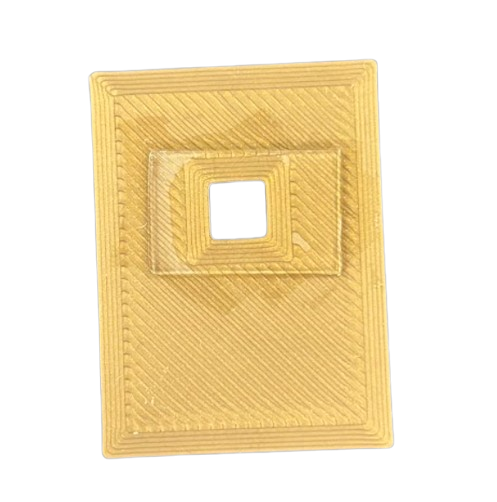
Silver-coated gratings with front-side illumination gave the clearest and most consistent resonances.
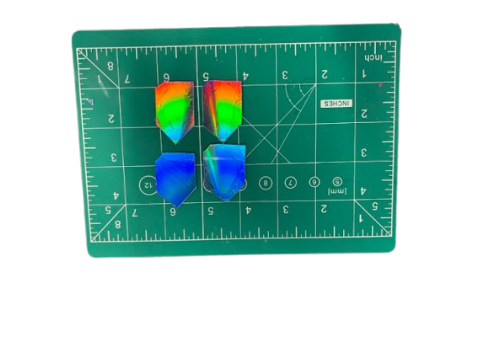
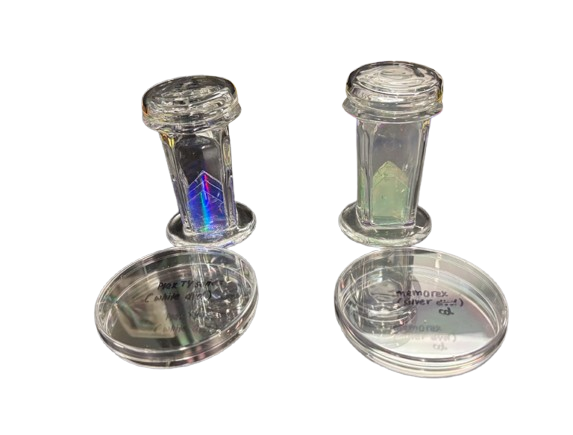
This study uses commercial optical discs as low-cost grating substrates for grating-coupled surface plasmon resonance sensing. Instead of using expensive nanofabrication, it takes advantage of the nanostructures already built into the discs and compares how metal coating, disc type, and illumination direction affect performance.
The workflow is organized into four stages. Each image can open a cleaning or preparation video so the process is easier to follow.
Cut, clean, and isolate the polymer grating substrate.

Apply Ag or Cu to form the plasmonic layer.

Measure grating geometry and surface morphology with AFM.

Collect reflectivity spectra and compare with simulation.
Use this section for your best schematics, AFM images, setup diagrams, and representative spectra.
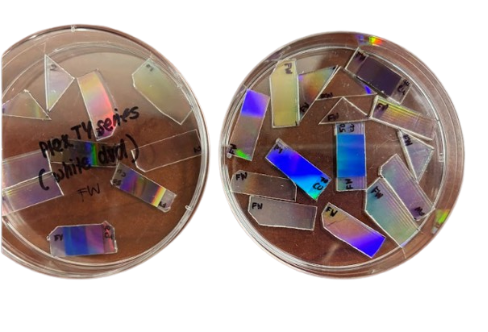
Front-side and back-side plasmon excitation on metal-coated optical disc gratings.
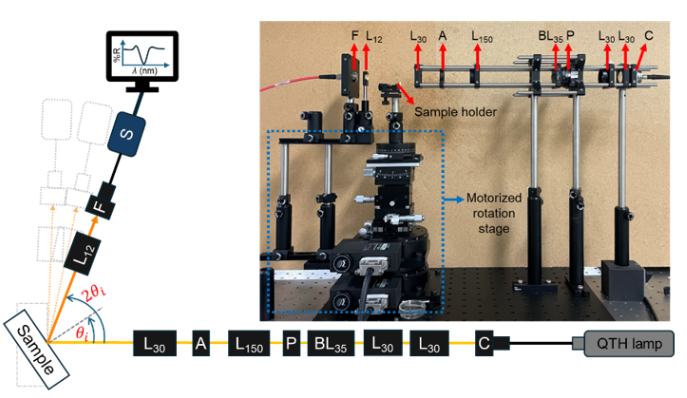
Optical path, angle control, polarization handling, and reflectivity collection system.

AFM-derived geometry and representative resonance behavior across substrates.
The results section highlights the main findings in a simpler format with stronger visual balance.
BD-R produced the sharpest resonances. Front-side illumination was more reproducible. Silver outperformed copper. CD-R showed the highest wavelength sensitivity even though its resonance features were broader.

| Substrate | Sensitivity | Summary |
|---|---|---|
| CD-R | 394 nm/RIU | Highest wavelength shift |
| BD-R | 321 nm/RIU | Best balance of clarity and consistency |
| DVD-R | 290 nm/RIU | Lowest sensitivity |
This project shows how common commercial materials can be turned into practical sensing platforms at lower cost.
Commercial optical discs can become functional plasmonic sensing substrates, reducing fabrication barriers for research, teaching, and future diagnostic use.
Future work can add microfluidics, protective coatings, and target-specific sensing chemistry for environmental or biomedical applications.
Description